The Enamel Review · Science
What do we own? Dental records in the age of scans
An ADA News column asks what the profession owns. Read from the chair, the question is also about scans, design files and the data a model learns from.
In a natural, human-quality voice · about 4 min · free when you register
Read aloud · 0:00 / 4:00 · the text follows along
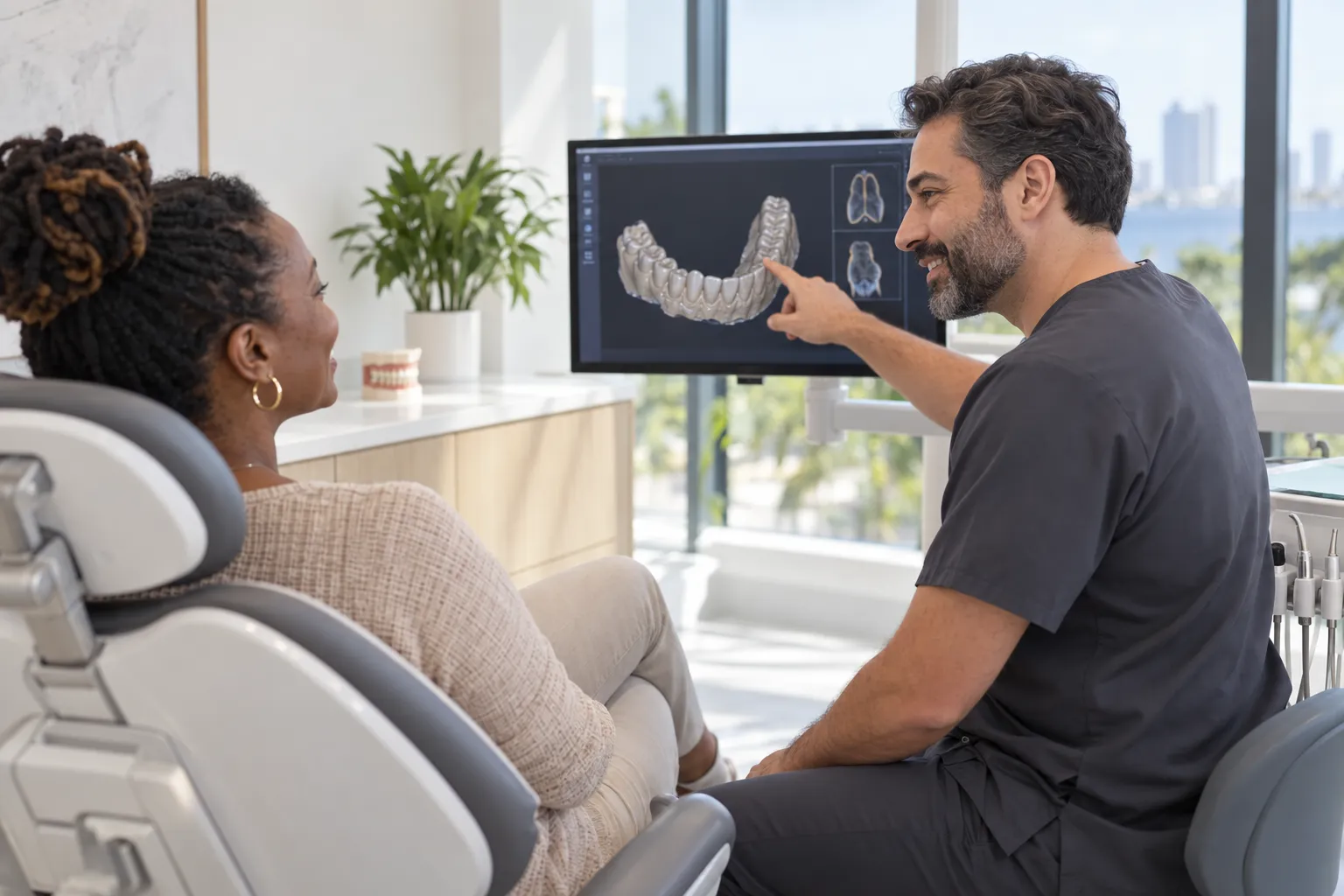
A column published in ADA News under the standing headline “My View” asked a deceptively plain question: what do we own? The framing there is professional — ownership of a practice, of a career, of the direction a profession chooses for itself. Read from chairside, though, the question has a second life that is worth separating out. A dental record used to be a folder in a drawer. It is now a stream: radiographs, a cone-beam volume, an intraoral scan, a set of photographs, restorative design files, and, increasingly, whatever an algorithm has inferred from all of it. Asking who owns that stream is no longer an abstraction.
What is actually inside a modern dental record?
Think of the record in three layers. The first is the captured layer — images and scans produced by a device, plus the clinical notes written alongside them. The second is the derived layer, which is newer and less well understood: segmented tooth meshes, automatically placed landmarks, arch measurements, caries or bone-level flags, and the outputs of software that measures things a human used to measure by hand. The Enamel Review has covered the research side of that shift in a piece on automated dental landmark detection and model analysis on 3D digital models. The third layer is the aggregate — what happens when thousands of de-identified records are pooled to train or validate a model. Each layer raises a different ownership question, and conflating them is how conversations about data get confused.
Who owns the scan, and who owns what a model learns from it?
In the United States, the common position is that the record itself — the physical or electronic file — is generally treated as the property of the entity that created it, while the patient holds enforceable rights of access, inspection and copy. Those access rights sit in the HIPAA Privacy Rule, a federal regulation administered by the Department of Health and Human Services, and specific retention periods and release mechanics are set by state law and dental board rules, which vary. That is the captured layer, and it is comparatively settled.
The derived and aggregate layers are less settled. A segmentation produced by a vendor’s software inside a vendor’s cloud is not obviously the same object as the scan it came from. Consent language in a new-patient packet may or may not extend to research use, product development or model training, and the license terms attached to the software may govern more than the practice realizes. None of this is legal advice, and no article can substitute for reading the actual agreements. It is simply worth noticing that the question “do I have my scan?” and the question “does anyone else have a copy, and what may they do with it?” are two questions, not one. Professional bodies are beginning to work through this in policy channels — the ADA’s own governance process runs on written submissions, as a related piece on testimony deadlines for House of Delegates reference committees describes.
Why does ownership matter at the chair?
Because treatment that spans years depends on records that span years. A full-mouth rehabilitation is sequenced against baseline images, prior impressions and a record of what was tried and what failed. A same-day full arch workflow — in-house milling with quick turnover, where a clinic qualifies for it — produces design files that matter enormously at the first reline, the first remake, or the moment a patient moves to another neighborhood and needs a clinician experienced in full-arch planning to pick up the thread. If those files are locked in a proprietary format, held on a server the patient cannot reach, or deleted on a retention schedule nobody mentioned, the practical result is a second full workup. Portability is not a philosophical nicety; it is the difference between continuity and starting over.
There is also a professional dimension. As more clinical judgment is mediated by software, the question of who owns the reasoning becomes real. A companion piece on large language model use in dental education touches the same nerve from the training side: tools that summarize, suggest and draft are now part of how the next cohort learns to think.
What is worth asking before the next scan?
Four questions cover most of it. Can a copy of the record be released in an open, non-proprietary format, and in what timeframe? How long are images, scans and design files retained, and what happens to them if the software vendor changes? Does the consent signed at intake cover uses beyond direct care, and can those be declined without affecting treatment? And who holds the license to the software required to open what is released?
The honest answer to “what do we own?” is layered rather than tidy, and it is changing faster than the paperwork describing it. The practical takeaway is small and entirely within reach: after any significant imaging appointment, request a copy of the record for personal archives, in a format that opens without a subscription, and store it somewhere you control. Patients who do this find that second opinions become easier and long-horizon planning becomes cheaper. Clinicians who make it routine find the conversation about data ends up shorter, not longer.
Comments
Comments publish after a one-click email verification — every voice here is a real one. Comments are reviewed before they appear.
Loading comments…